




Why Thailand for dog food OEM
Thailand is one of the world’s largest pet food exporters. Few other countries offer so many experienced factories, and they work with established export procedures. According to the Department of International Trade Promotion (DITP) under the Ministry of Commerce, Thai pet food exports exceeded USD 3.28 billion (THB 111 billion) in 2025, representing an 8.15 per cent year-on-year increase. That makes Thailand the world’s second-largest supplier, behind Germany.
For a brand owner, that scale makes three practical differences:
- Raw material access. Thailand has large poultry and fish processing industries. Chicken, chicken meal, fish and tuna are typical dog food proteins and are available locally at competitive prices.
- Export experience. Thai factories already ship to markets with strict rules, including Japan, the EU, the US and Australia. Their teams know the documentation, so you don’t have to work it out from scratch.
- Government support. The Department of Livestock Development (DLD) has identified pet food and frozen poultry as strategic “spearheads” to penetrate both traditional and emerging markets worldwide in 2026.
The home market is also worth a look if you plan to sell locally. In 2024, Thai consumers spent an estimated $1.6 billion on commercially prepared pet food, of which $1.3 billion was specifically for dog and cat food.
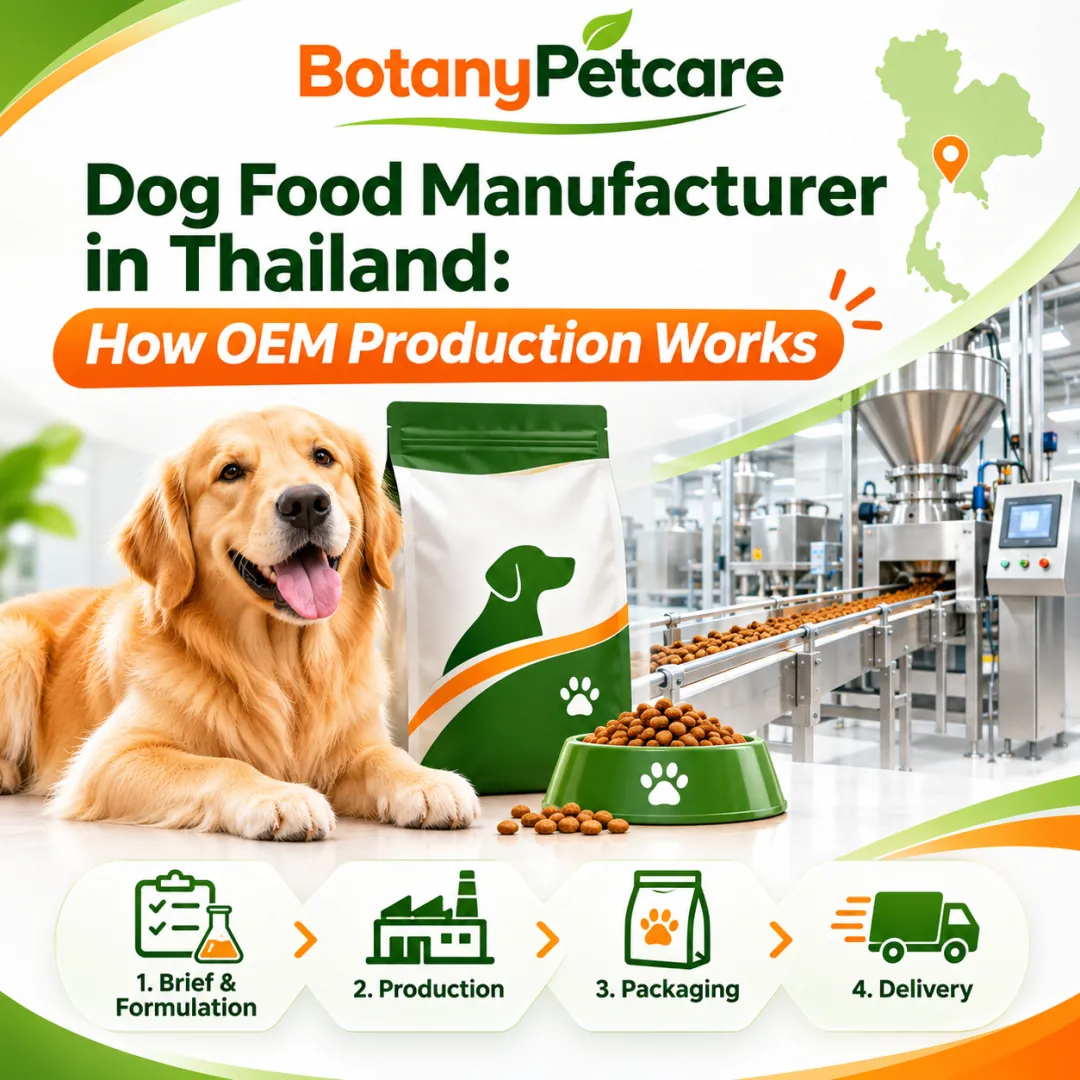
How OEM dog food production works, step by step
Most OEM projects follow the same sequence. The timing varies, but the order rarely does.
1. Brief and consultation. You share the target dog, positioning, format, target price and markets. The factory confirms what it can produce on its existing lines.
2. Recipe development.The R&D team proposes a formula, either adapted from an existing base or built new.
3. Sampling. You receive lab samples to check smell, texture, kibble shape and palatability. Expect two or three rounds.
4. Testing. Nutrient analysis against the guaranteed analysis, shelf-life checks and, where relevant, palatability trials.
5. Packaging and labelling. Artwork, label text and claims are checked against the rules of each sales market.
6. Registration. The product is registered or notified where required, both in Thailand and in the destination country.
7. First production run. This includes quality checks, batch records and a certificate of analysis for each lot.
8. Export shipment. The factory prepares the export documents, and you or your freight forwarder book the shipping.
Steps 5 and 6 can run alongside sampling. Brands that leave registration until the recipe is final often lose the most time.
Recipe and kibble options
A good dog food manufacturer will offer more than one way to reach your recipe. These are the main choices you’ll make.
Format
| Format | What it is | Typical use |
|---|---|---|
| Dry kibble (extruded) | Cooked under heat and pressure, then dried and coated | Everyday complete food, best cost per meal |
| Baked kibble | Baked in an oven instead of extruded | Premium positioning, different texture |
| Wet food (can, pouch, tray) | Cooked and sterilised in sealed packs | Complete meals, toppers, picky eaters |
| Treats and chews | Jerky, biscuits, dental chews, freeze-dried | Add-on SKUs, training, functional benefits |
Not every factory runs every format. Ask which lines are in-house and which are subcontracted, because subcontracting affects quality control and lead time.
Recipe positioning
Common OEM dog food positions include:
- Life stage: puppy, adult or senior, plus all-life-stage formulas
- Breed size: small breed, medium, or large and giant breed
- Diet type: grain-free, limited ingredient, high protein, single or novel protein (duck, lamb, fish)
- Functional: joint support, skin and coat, digestion, weight control
If you plan to export, ask the R&D team which nutrient standard the formula is built against. Many export markets work with AAFCO (US) or FEDIAF (EU) nutrient profiles. A “complete and balanced” claim on the label needs a formula that meets one of them.
Kibble size and shape
Kibble size is one of the cheapest ways to make a product fit its target dog. Small-breed recipes use smaller, thinner pieces that are easier to chew. Large-breed recipes use larger pieces that encourage chewing and slow eating. Shape matters too, because some brands use a distinctive kibble shape as part of their identity.
Changing size or shape usually means a different extrusion die. Ask whether the factory already has the die you want, or whether you’ll pay for a new one.
MOQ and lead time
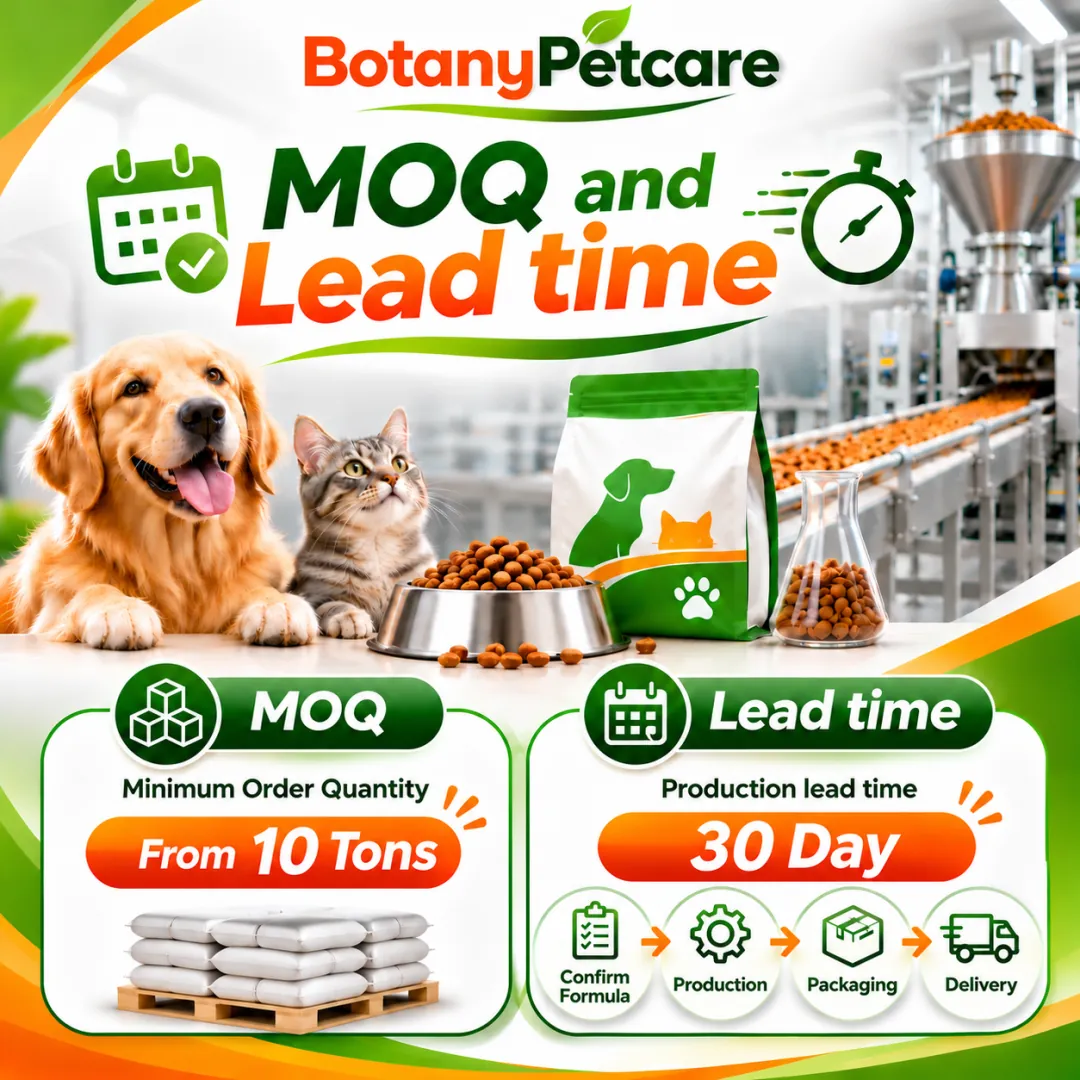
Minimum order quantity (MOQ) is the smallest production run a factory will accept for one SKU. It exists because each run carries fixed costs: line changeover, cleaning, raw material purchasing and quality checks. A small batch costs almost as much to set up as a large one.
The factors that most affect MOQ for dog food are:
- Format. Dry kibble is usually produced in larger batches than wet food or treats.
- Recipe. An existing base recipe needs a lower MOQ than a new formula with special ingredients.
- Packaging. Printed bags and pouches have their own supplier minimums, often higher than the food MOQ. Some factories offer stock packaging with labels to get around this for a first order.
- Number of SKUs. Splitting one order into many flavours or pack sizes can push each SKU below its minimum.
Lead time works the same way. Repeat orders of an approved recipe are the fastest. A first OEM order takes longer because of development, packaging printing and registration.
Certifications to look for
Certifications show that a factory’s food safety and quality systems have been audited by a third party. Ask for current certificates, not just logos on a website, and check the scope covers pet food production at that site.
| Certification | What it shows | Why it matters to you |
|---|---|---|
| GMP | Good manufacturing practice for hygiene and process control | Baseline requirement for a credible factory |
| HACCP | Hazards are identified and controlled at critical points | Expected by most importers and retailers |
| ISO 22000 / FSSC 22000 | A full food safety management system | Often required by larger retail chains |
| BRCGS or IFS | Retailer-led food safety standards | Common requirement for UK and EU supermarket listings |
| Export establishment approval | The destination country has approved the plant | Required by some markets before you can ship at all |
The last row is often missed. Some destination authorities approve or list individual factories before they accept pet food from them. A factory can be fully certified and still not be approved for your market. Ask for its list of approved export destinations in writing.
Export documents
For each export shipment of dog food from Thailand, expect some combination of these documents:
- Health certificate.Issued by Thailand’s Department of Livestock Development, signed by an official veterinarian, and written to the destination country’s requirements.
- Certificate of analysis (COA).Lab results for the batch, such as nutrients and microbiological tests.
- Certificate of origin. Needed to claim reduced import duties under trade agreements, for example within ASEAN.
- Commercial invoice and packing list.Standard customs documents.
- Product information and formula declaration. Some importing authorities ask for this before the first shipment.
- Import permit. Some countries require one, and it’s usually arranged by the importer before the goods ship.
Rules change, and they differ by product. Canned food, kibble and chews can fall under different certificates in the same market. Confirm current requirements with your importer and the factory’s export team before each new market launch. A manufacturer that handles your paperwork in-house will save you time and reduce the risk of goods being held at the border.
Questions to ask a dog food manufacturer before you sign
1. Which formats do you produce in-house, and which do you subcontract?
2. Will my recipe be exclusive, and who owns the formula?
3. What is the MOQ per SKU, and what is the MOQ for packaging?
4. Which nutrient standard is the formula built against?
5. Which countries is your plant approved to export to?
6. Can I see current certificates and a recent audit summary?
7. Who prepares the export documents, and what do they cost?
8. What happens if a batch fails a test, both on the timeline and on cost?
Frequently asked questions
How much does it cost to make dog food with a manufacturer in Thailand?
What is the minimum order for OEM dog food?
Can a Thai dog food factory ship to Europe or the US?
How long does it take to launch an OEM dog food brand?
Do I need my own nutritionist to work with a dog food manufacturer?
Request a quote
Planning a dog food line for your brand? Botany Pet Care can take your idea from brief to first shipment. Our team will help you choose a recipe and kibble size that fit your dog and your price point. See our dog food OEM Thailand service for the formats we produce, or send us your target market, format and expected volume. We’ll come back with recipe options, MOQ and an indicative timeline.